The Ais people at Turkey Creek
Before there was a Tillman post office or a General Development Corporation street grid, the freshwater springs feeding Turkey Creek drew the Ais, a non-agricultural coastal nation whose shell middens still mark the creek's mouth. They were here when Ponce de León's ships passed in 1513 and they were gone by 1763.
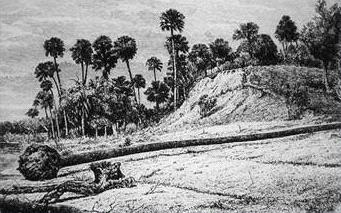
The Ais lived on the Atlantic side of Florida from roughly Cape Canaveral south through what is now Vero Beach. Their capital was somewhere near the present St. Lucie inlet. Turkey Creek was their northern frontier, and the freshwater springs at its head drew them inland to a site they used for centuries.
The standard archaeological estimate puts continuous occupation of the Turkey Creek complex at over a thousand years before European contact. The shell middens, the dietary record left in heaps of oyster, conch, and clam shells, run deep at the creek’s mouth. The Florida Master Site File lists multiple sites in the immediate area, all unexcavated or only partially excavated, all sensitive.
Who the Ais were
The Ais (pronounced roughly “ah-eez”) were one of the Atlantic-side coastal nations the Spanish encountered when their treasure ships started wrecking on Florida’s east coast in the 16th century. Their territory ran from roughly the modern Brevard-Indian River county line south through Martin County, with the population concentrated in villages on the lagoon, the barrier island, and the inlets.
They were not agriculturalists. Most Florida nations of the interior, the Timucua to the north and the Apalachee to the west, grew corn, beans, and squash. The Ais didn’t. They lived on the lagoon’s productivity directly: fish, shellfish, sea turtles, manatees, and the freshwater resources of creeks like Turkey Creek that drained the pine flatwoods into the brackish lagoon.
This dietary record is what makes their archaeology so visible. A maize-and-beans diet leaves cookware and storage pits but not much else. A diet centered on oysters and clams leaves shell heaps that can be ten feet deep and acres across. Brevard County’s Indian River coast is dotted with Ais shell middens, some of them survived into the 20th century before being mined for road fill.
Why Turkey Creek
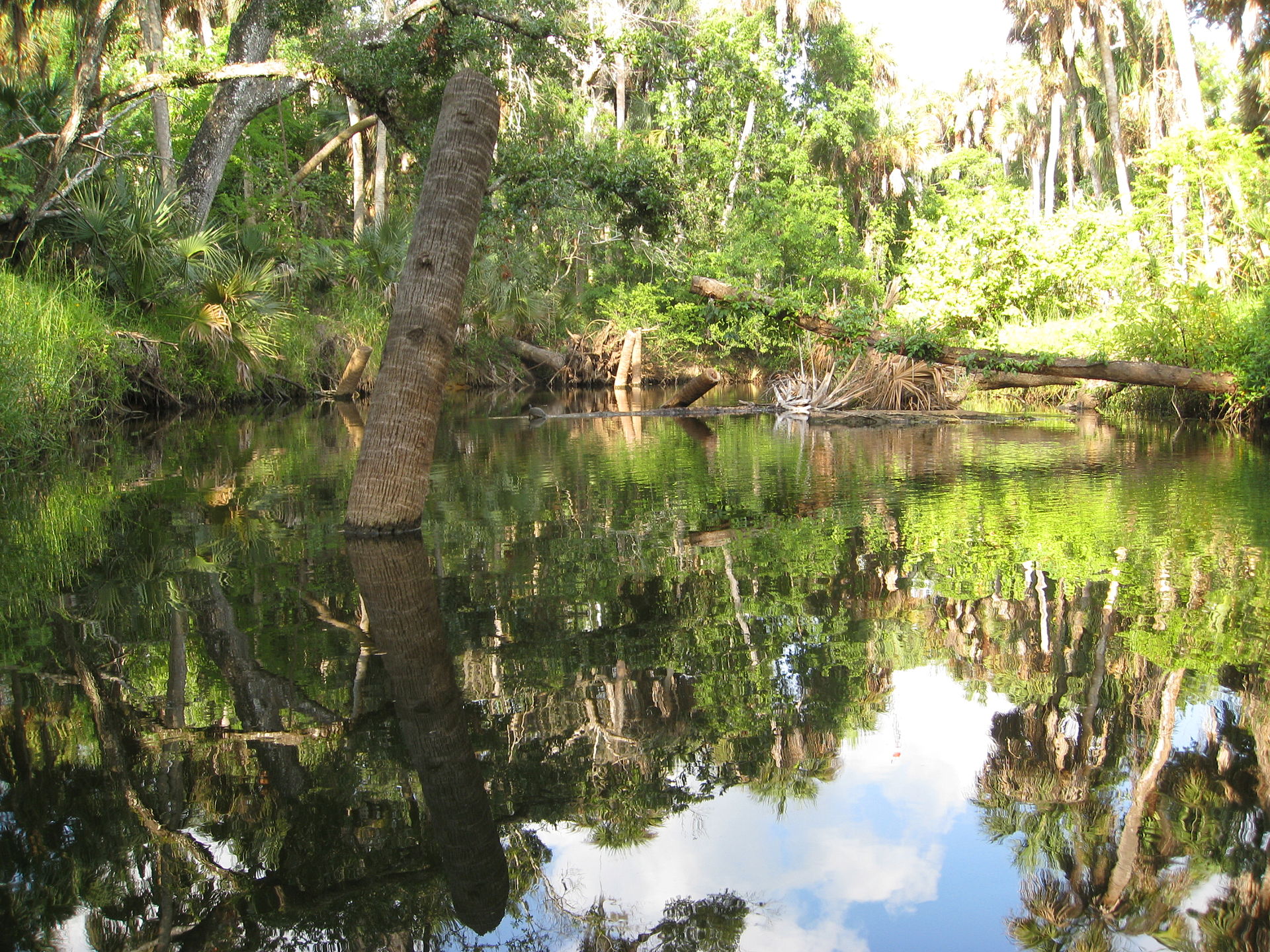
Turkey Creek is one of the few sizable freshwater inflows to the Indian River Lagoon in southern Brevard County. The springs at its head, now protected within the Turkey Creek Sanctuary, deliver clear water through limestone-bottomed pools into the slower brackish water of the creek’s lower reach.
For the Ais, this combination, freshwater for drinking and cooking, brackish water for shellfish, ocean access through the lagoon’s inlets, was ideal. Turkey Creek was useful in every season. Dry months that lowered the lagoon’s salinity didn’t affect the spring’s flow. Hurricane storm surges that fouled coastal water sources didn’t reach far enough inland to ruin the springs.
The site complex at Turkey Creek includes the main midden at the creek’s mouth, smaller deposits along the bluffs above the spring, and what appear to be ceremonial or burial features deeper inland. The Florida state site file lists the major component as 8BR43, the Brevard County designation for the Turkey Creek midden complex, though the full extent has never been mapped in publication-quality detail and probably never will be, to protect against looting.
Contact with Europeans
The first Europeans to encounter the Ais were probably members of Juan Ponce de León’s 1513 expedition. Ponce sailed north along Florida’s east coast that spring, then south back along the same coast. He didn’t establish contact with named groups, but his pilot’s log records anchorages on what was almost certainly Ais territory.
Sustained contact came after 1565, when the Spanish founded St. Augustine. Treasure fleets returning to Spain through the Bahama Channel routinely wrecked on Florida’s east coast, and survivors who made it to shore landed on Ais beaches. The Ais took them, usually as slaves, sometimes as ransom merchandise to be sold to other Indians or back to the Spanish.
The historical record of the 16th and 17th centuries treats the Ais as fierce, isolationist, and uninterested in conversion. Spanish Jesuits and Franciscans tried, repeatedly, to establish missions in Ais country. None survived. The Ais maintained autonomy until the structural collapse of Florida’s native societies in the early 18th century.
What killed them
The Ais are gone. They didn’t merge with the Seminole; the Seminole are a later, Creek-derived nation that moved into Florida from Georgia and Alabama in the 18th century. The Ais were extinct as a distinct people by roughly 1760-1763.
Two main causes. Epidemic disease, especially smallpox and yellow fever, killed enormous percentages of every Florida native population from the 1600s on. The Ais, despite their isolation, were exposed through shipwreck contact and limited trade. And the slave trade, run by English-allied Creek and Yamasee raiders out of South Carolina and Georgia, swept the Florida peninsula clean of Spanish-allied or unallied natives in the early 1700s.
By the time Britain took Florida from Spain in 1763, the entire pre-contact native population of the peninsula was either dead, fled to Cuba with retreating Spanish forces, or absorbed into the small remnant Indian populations consolidating in interior Florida. The Ais specifically appear to have ended through a combination of disease, slave raids, and a final retreat to Cuba with the last Spanish administrators.
There are no Ais descendants who identify as such today.
What’s still there
The Turkey Creek site complex remains protected, mostly within the Turkey Creek Sanctuary that the City of Palm Bay manages on the creek’s lower reach. The middens haven’t been fully excavated. The state’s preservation policy on sites like this is conservative: leave them undisturbed unless development threatens them directly, in which case salvage archaeology runs before construction.
The Sanctuary’s interpretive signage acknowledges the Ais occupation in general terms. There’s no detailed site map publicly available, and that’s deliberate. Florida’s archaeological sites are routinely looted; specific locations get withheld from publication.
What a visitor can see on the boardwalks above the creek is the landscape the Ais used. The spring still flows. The cypresses are descendants of the trees that stood when the middens were active. The brackish water at the creek’s mouth still produces oysters, though commercial harvesting stopped decades ago because of lagoon water-quality problems unrelated to the spring itself.
What the record looks like
Documentary evidence for the Ais is thin and Spanish-sourced. The standard reference is John Hann’s Indians of Central and South Florida 1513-1763, which compiles what survives in colonial archives. John Swanton’s 1922 Bureau of American Ethnology bulletin is older but useful as an early consolidation. Site reports in the Florida Anthropologist journal cover specific Brevard and Indian River county excavations.
What’s missing is anything from the Ais themselves. They left no writing. Their material culture, ceramics, beads, bone tools, was simple compared to maize-growing nations to the north. The shell middens are the largest physical record of their occupation, and the middens are essentially trash heaps: enormously informative about diet and chronology, mostly silent about belief, kinship, language, or anything else.
That gap matters. The Ais were here for at least a thousand years and probably longer. They knew the springs at Turkey Creek as intimately as anyone has ever known them, and almost everything they knew is gone.
Further Reading
As an Amazon Associate we earn from qualifying purchases.