Palm Bay incorporates as a city, 1960
Palm Bay became a chartered Florida municipality on January 16, 1960. The incorporation was driven by the General Development Corporation's 1959 land purchase and the need for a local government that could manage the planned subdivisions before they generated more population than the existing unincorporated structure could handle.
Palm Bay incorporated as a Florida municipality on January 16, 1960. The new city had a charter, an elected mayor and council, and a population somewhere between the 1950 census figure of 596 and the 1960 census figure of 2,808.
The incorporation was a direct response to General Development Corporation’s purchase of 41,000 acres west of the existing settlement six months earlier. Without municipal government in place, the platted subdivisions GDC was preparing to sell would have developed entirely under Brevard County’s jurisdiction, with no local mechanism to provide services or extract local revenue.
What was there before incorporation
Pre-1960 Palm Bay was an unincorporated Brevard County community. There was no mayor, no city council, no police department, no fire department, no city services other than what the county provided. The U.S. Post Office was federal, operating under the Palm Bay name since 1925. The school served the community as part of the Brevard County school system. The closest incorporated city was Melbourne, four miles north, which had its own services and tax base.
Florida’s pre-1960 county-government model put most service responsibilities on the county for unincorporated areas. Brevard County’s road department maintained the (limited) road network. The Sheriff’s Office provided law enforcement. Volunteer fire service covered fire response. This was adequate for a 600-person rural community. It was not adequate for what GDC was about to build.
The 1959 catalyst
GDC’s purchase announcement in mid-1959 made the structural problem visible. The company was planning to plat tens of thousands of residential lots and was preparing to sell them aggressively to out-of-state buyers. As lots were sold and houses started to be built, the area would generate demand for services at a scale no unincorporated rural community could handle through county-government alone.
The choice for residents and property owners was straightforward. Either incorporate as a city, with the authority to tax, zone, regulate, and provide services within the new boundaries, or accept that all governance of the GDC development would happen at the county level. The local consensus moved toward incorporation.
The incorporation petition went through Brevard County’s pre-filing process in late 1959. The charter, drafted by local attorneys, established a council-manager form of government with an elected mayor and a small council. Voters approved the charter. Florida’s incorporation procedures were completed in time for the January 16, 1960 effective date.
The 1960 boundaries
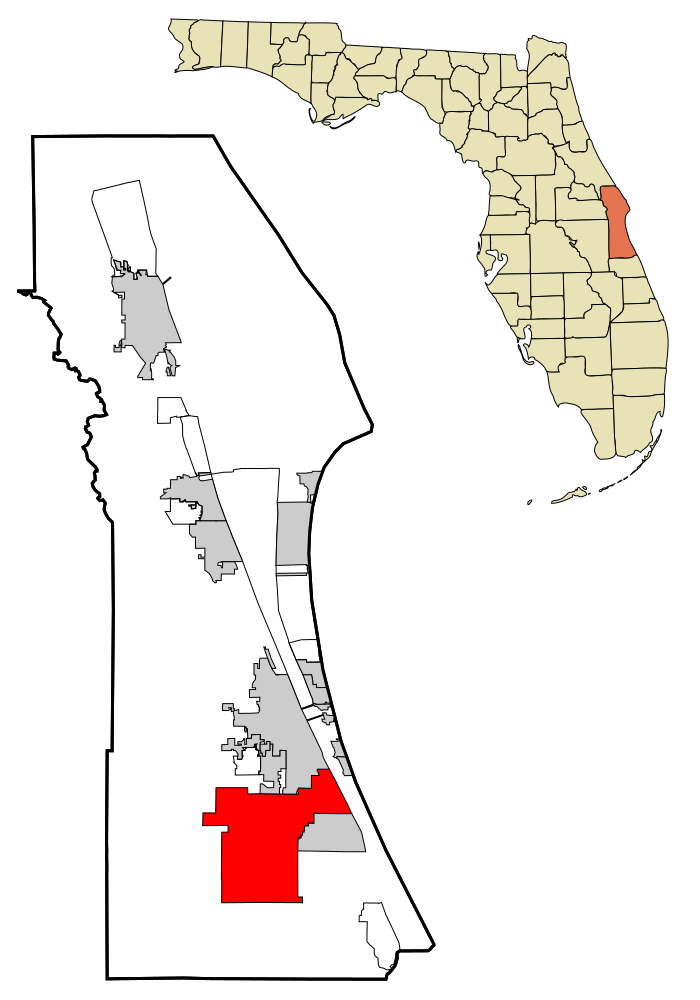
The original 1960 city boundaries were modest. The city included the pre-existing Tillman/Palm Bay community on the western shore of the Indian River, plus a defined block of the GDC purchase area immediately west of the historic settlement. The boundary did not initially include the full GDC tract; significant portions of what GDC was about to plat remained in unincorporated Brevard County in 1960.
Over the following decade, Palm Bay annexed additional territory in stages. By the late 1960s, most of the GDC platted subdivisions were inside the city. By the 1980s, Palm Bay had annexed the bulk of its current footprint, which now spans approximately 100 square miles, the largest land area of any Brevard County municipality.
The annexation pattern reflected the development pattern. As GDC sold lots and built infrastructure in new subdivisions, the city annexed those subdivisions to provide municipal services. The annexations were typically voluntary on the part of GDC, since incorporation under Palm Bay was preferable to unincorporated county status for the company’s marketing purposes.
Early city government
The first elected mayor and council took office in early 1960. The council-manager structure separated the political leadership (elected mayor and councilors) from the day-to-day administration (a city manager hired by the council). This is the standard Florida small-city government model and remains Palm Bay’s framework today.
The first city operations were modest. A small police force, a fire department, a public works function covering road maintenance and basic utilities, and an administrative office covering planning, zoning, and finance. The city’s first budget was a few hundred thousand dollars. The first city hall was a small building on Palm Bay Road.
By the late 1960s the city’s operations had grown to match the population. Police, fire, water and sewer, parks, planning, code enforcement, all expanded. The city’s budget grew from sub-$1 million in the early 1960s to multi-million dollar territory by 1970.
Why the timing mattered
Palm Bay’s 1960 incorporation came at the exact moment when GDC’s lot sales operation was getting underway. The city existed in time to manage the development from the start, not retroactively. This is unusual in Florida history; many of the state’s fast-growing municipalities incorporated after their development had already begun and had to backfill municipal services into existing development patterns.
Because Palm Bay incorporated before significant GDC construction, the city had jurisdiction over land use, zoning, and infrastructure standards for most of the GDC build-out. The lot dimensions, road widths, drainage standards, and zoning categories were established through city ordinances that GDC’s development plans then had to conform to. This was the case even where the city’s standards were modest by modern standards; in 1960 most municipal regulation was minimal compared to current practice.
GDC and the city had a generally cooperative relationship in the 1960s and 1970s. The company built the infrastructure (streets, drainage, water and sewer in some areas) and dedicated it to the city upon completion. The city accepted the dedications and took on maintenance responsibility. Property tax revenues from the developed lots funded the maintenance.
The arrangement worked from a city-finance standpoint as long as GDC kept building. When the company’s sales slowed in the 1980s and collapsed in 1990, the city was left with a large platted footprint, an extensive infrastructure inventory, and a slower-than-expected revenue ramp from the unbuilt portions of the GDC plat.
What the charter says
Palm Bay’s original 1960 charter has been amended multiple times. The current charter, available through the city clerk’s office, establishes the council-manager form, defines elected positions, sets terms, and lays out basic governance procedures. The charter has the typical home-rule provisions allowing the city to act in any area not preempted by state law.
The city operates under a five-member council plus a separately-elected mayor. Councilors serve staggered terms. The city manager is appointed by the council and serves at its pleasure. The structure is standard for Florida cities of Palm Bay’s size; it has not been a source of controversy or significant reform proposals.
The longer arc
Sixty-five years after incorporation, Palm Bay is the largest city in Brevard County by population and by land area. It has the largest municipal budget in Brevard. It has the largest police force and the largest public works inventory. It is, in measurable terms, the principal municipal government in southern Brevard County.
None of that was guaranteed in 1960. The 596-person community that incorporated could have stayed small, could have failed to keep pace with GDC’s development, could have been outmaneuvered by a neighboring city’s expansion. The choice to incorporate, made at a moment when the alternative was to let county government handle everything, established Palm Bay as an independent local jurisdiction at exactly the moment that independence became valuable.
The city’s founders, mostly local property owners and citrus growers, recognized that the GDC development was going to transform southern Brevard County one way or another. Their choice was whether the transformation would happen under their local political control or under remote county-level control. They chose local control. The city that resulted is the one we have.
Further Reading
As an Amazon Associate we earn from qualifying purchases.